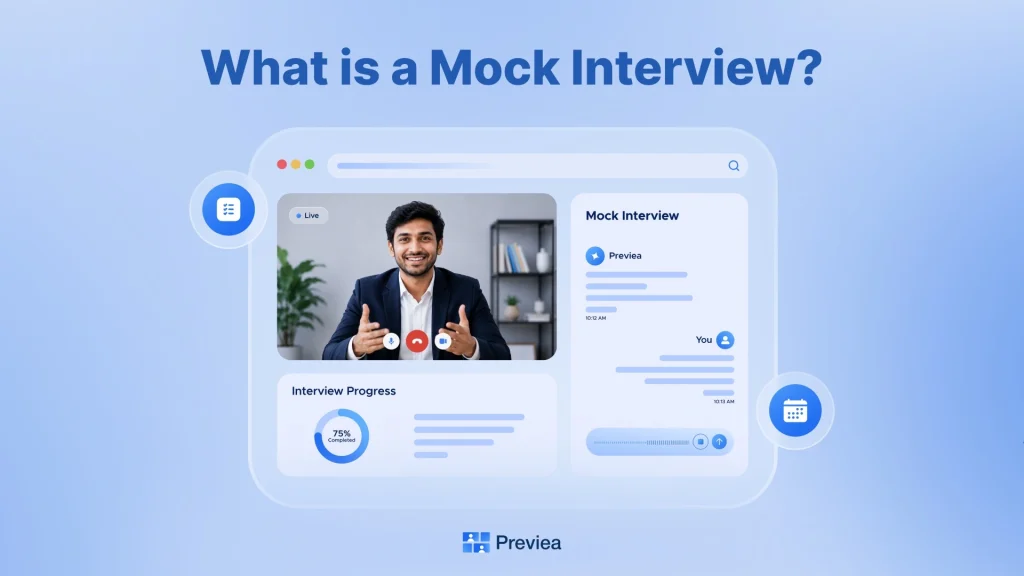
A mock interview is a practice session that recreates real interview conditions where candidates prepare their answers and improve their interview skills before the actual interview. Recent graduates, career changers, working professionals, and students are all using mock interviews to improve their answers, communication skills, confidence, and overall interview performance.
Candidates often struggle in interviews because they face the interview unprepared, not because they lack the required skills. Interview anxiety, poor answers, and weak interview performance are now widely reported as the leading causes of interview failure. That’s the reason many candidates now use mock interviews before facing the actual job interview.
This mock interview guide breaks down the meaning of a mock interview and how mock interviews improve interview performance. Let’s learn about different types of mock interview formats and most importantly, what to expect during a mock interview practice session.
What Is the Purpose of a Mock Interview?
The purpose of the mock interview is to help candidates prepare for real interviews through continuous practice and feedback sessions. You get access to a simulated job interview environment, which improves your performance through guided self-assessment.
Let’s have a clear overview of the core purpose of the mock interview:
1. Practice Job Interview Under Pressure
Mock interviews recreate the same pressure and anxiety you’d face in a real interview. That’s the point you get the opportunity to practice through mock interviews on how to stay calm, think knowledgeably, and deal with pressure. By knowing how to respond immediately, you become comfortable with professional interview conversations.
2. Identify Weaknesses
A mock interview offers an honest self-assessment process to know where your answers fall short and your pacing slips. You can spot the weak points of your habits or presentation that may affect your interview results. Weak examples, poor eye contact and unclear answers, all become visible through mock interviews.
3. Receive Feedback
You get objective feedback from a real interviewer after each mock interview session. It highlights your general impression, attitude and clarity and specific areas in need of improvement. Thus, responses are improved and preparation is made better for future opportunities. Each mock interview gives you clear feedback, where you improve yourself.
What Are the Benefits of Mock Interviews?
A mock interview gives you a safe, low-stakes environment to rehearse answers, refine your delivery, and get targeted feedback before the actual interview.
Have a closer look at the 3 core benefits of mock interview practice.
1. Confidence Building
A mock interview builds confidence for a job interview through allowing you access to repeat realistic interview practice sessions until your answers feel natural instead of rehearsed.
You will understand familiar interview questions and your response skills through repeated sessions rather than a single attempt. This steady process even improves your stress management.
2. Constructive Feedback
A mock interview provides constructive feedback by scoring your answer quality, tone, and presentation right after each session. That immediate breakdown gives you a clear plan to fix specific weak spots before your real interview. Candidates evaluate answer quality and the overall presentation. These insights work as the focused plan for continuous improvement.
3. Interview Skills Refinement
Mock interview sessions assess more than your answers, including your communication style, tone, confidence, and body language. You can practice polishing your answers, combining all these major factors. Though these might be subtle refinements, you will leave a lasting impression on interviewers.
There are many other benefits that you should be aware of.
| Benefit | What It Does | Who It Helps Most |
|---|---|---|
| Builds Confidence | When you practice repeatedly, you become confident in delivering any of your answers. | First-time job seekers, Graduates, Career changers |
| Reduces Anxiety | Makes real interviews feel more familiar and easier to manage. | Candidates who get nervous under interview pressure. |
| Provides Constructive Feedback | Points out exact gaps in your answers | Anyone preparing for competitive or high-stakes interviews. |
| Sharpens Answers | Improves your wording choice and removes filler | Candidates who are preparing for facing technical questions. |
| Improves Interview Etiquette | Camera practice trains posture, tone, and eye contact | Candidates on video or virtual interviews |
| Teaches Better Questions | Helps candidates ask relevant questions at the end of the interview. | Candidates who are stuck when asked any questions for us |
What Are the Types of Mock Interviews?
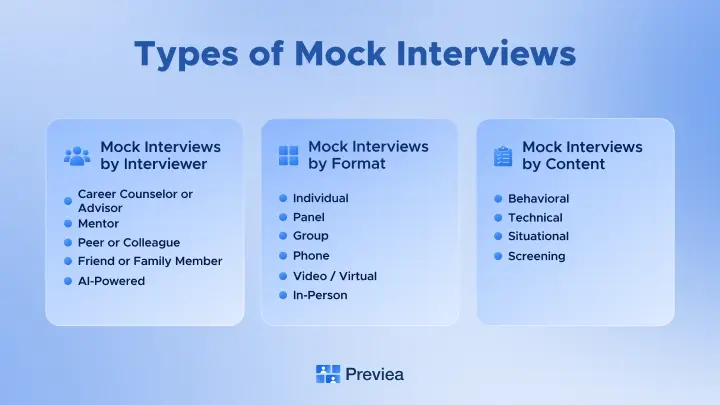
Mock interviews come in different formats. Each one is designed to fit different stages of preparation. For example, some trial job interview sessions are focused on realism, others on comfort. You have to choose the right one based on what you need to work on most.
1. Mock Interviews by Interviewer
Here are the main options you should know about based on who is taking your interview:
- Career Counselor or Advisor: A career counselor is the one who mainly runs a structured mock interview with preset questions. They offer unbiased feedback based on your overall interview performance. This type is very common at university career centers, especially among students and recent graduates entering the job market.
- Mentor: A mentor offers in-depth industry knowledge and personal experience in the interview process. Even their guidance extends beyond one interview, as their feedback is tied to long-term career paths. They basically help you build stronger professional habits and prepare for future opportunities.
- Peer or Colleague: Peers and colleagues can be your practicing partner when you may feel informal but realistic. It works best with someone who’s held the role you’re targeting. Here, they have the knowledge of day-to-day expectations and can ask questions a real interviewer would actually ask.
- Friend or Family Member: A friend or family member offers the lowest-pressure option available. There is no judgment or evaluation process. You just practice saying answers out loud. It would be a good starting point before moving to more formal mock sessions.
- AI-Powered Mock Interview: An AI-powered mock interview offers an on-demand practice option. This is what you can access at any time you want. You will get instant data-driven feedback right after each session. These tools offer features that analyze your responses and give feedback on answer quality.
2. Mock Interviews by Format
The format of your mock interview matters as much as who runs it. Through each of the formats, you will be trained with different skill sets for different setups.
- Individual or One-on-One Mock Interview: Individual mock interview format, which depends on one interviewer and one candidate involved throughout the session. It seems like almost all first-round interviews. But you will get detailed feedback and enough time to improve your answers.
- Panel Mock Interview: A panel mock interview is where you answer in front of multiple interviewers. They may ask questions from different perspectives. This is mainly for senior and high-stakes job interview preparation. Through it, you build confidence in quick thinking and give the best possible answers.
- Group Mock Interview: A group mock interview connects multiple candidates together in the same session. It is like cohort-style hiring rounds. For instance, employers observe communication. Some even evaluate your capability in teamwork and leadership.
- Phone Mock Interview: This type of phone mock interview is conducted without any facial expressions. It assesses clear and paced speech without relying on visual cues. So, listening skills are just as important as your answers.
- Video / Virtual Mock Interview: A video or virtual mock interview helps you prepare for the remote hiring process. This would include tech checks before the session. The interviewer evaluates your camera presence, including your eye contact and virtual etiquette during the conversation.
- In-Person Mock Interview: An in-person mock interview is closely like a real set interview. That means it is closest to traditional face-to-face interviews where you mainly get practice on how to maintain body language. This includes everything, starting from posture, hand gestures, and eye contact to professional greetings.
3. Mock Interviews by Content
The content of a mock interview defines exactly what skill you are refining. Here are some common types you should know about:
- Behavioral Mock Interview: A behavioral mock interview helps you prepare based on past-experience questions. You will prepare your answers using the STAR method. The answers will be structured around the situation, task, action, and result.
- Technical Mock Interview: A technical mock interview targets role-specific questions and helps you prepare based on them. It tests the exact skills your job demands. This may include challenges, case studies, or system design questions. It works best for engineering and analytical roles.
- Situational Mock Interview: A situational mock interview session is mainly designed with rapid-fire questions. It basically tests your pressure-handling abilities. It works best for leadership roles where quick thinking with the best judgment answer matters most.
- General / Screening Mock Interview: A screening mock interview helps candidates prepare for broad, introductory questions. It is basically like early-stage phone screens. Recruiters evaluate whether you are fit before deeper rounds. This format works well as your first practice run.
What to Expect at a Mock Interview?
A mock interview is designed with a clear interview structure that completely resembles a real interview stage. So here is what you can expect during the overall process:
- Introduction & Warm-up: The process starts with a brief introduction. This typically lasts 2–5 minutes, where you will likely ease yourself into the process. You settle yourself with the professional flow before answering formal questions. You discuss your target role and professional background.
- Behavioral Questions: At the next stage, the interviewer heads up for questioning. The session lasts roughly 10–15 minutes. It starts with the interviewer asking experience-based question types. They explore your past decisions and achievements. All in all, you have to answer with structured examples that should clearly clarify relevant skills and what you have done till now.
- Role-Specific or Technical Questions: Next, the discussion changes to responsibilities directly related to your target position. The interviewer asks some relevant questions to assess practical knowledge and technical ability. Depending on the job, you may explain processes and how to solve problems. This session lasts over about 5–10 minutes.
- Candidate Questions to Interviewer: You may get a short time to find what to ask the interviewer about the role, company, or team. This stage becomes important where the interviewer defines curiosity and professional interest. The interviewers typically set about 5-7 minutes for conversation.
- Feedback and Debrief Session: The feedback session typically lasts for about 10 minutes, following the end of the interview. In this session, the interviewer will discuss your strengths. You can identify your improvement areas and preparation process.
- Action Plan for Improvement: The session ends with a personalized performance review. It basically summarizes the most important takeaways. You will leave with clear priorities and specific goals set. You will get guidance for your next practice session and strengthen future interview performance. The time duration would be 5-7 minutes.
What Questions Are Asked in a Mock Interview?
In mock interviews you will be asked common questions that are based on your background, skills, work experience, achievements and problem solving skills.
1. Typical Mock Interview Questions
Common interview questions help you to introduce yourself and explain your skills in a variety of ways. The questions typically include introduction, motivation, experience, behaviour and closing questions for a perfect ending.
Here are some of the examples of strong mock interview questions:
- Introduce yourself.
- What are your strengths and weaknesses?
- Why do you want to work for this company?
- Where do you want to see yourself in five years?
- Why should we hire you?
- Tell us about your professional experience.
- How do you stay organized while doing multiple tasks?
- What are your salary expectations?
- When would you be available to start?
- Do you have any questions for us?
2. Behavioral Mock Interview Questions
Behavioral mock interviews are designed with situation-based questions. Interviewers assess how you handle real workplace scenarios. They want to know about your performance on deadlines, teamwork, and pressure.
Some of the questions in this range are like:
- Tell us about a case where you disagreed with a coworker. How did you resolve it?
- Let us know a situation where you received criticism and how you responded.
- Give an example of when you had to meet a tight deadline.
- How do you coordinate with different team members?
- Have you ever faced a roadblock you faced on a project?
3. Technical and Role-Specific Mock Interview Questions
Technical and role-specific mock interviews evaluate whether you can perform the responsibilities of your target job. For instance, they ask job-specific questions based on the position. They target the industry and required skills.
Here are some common question patterns you may face:
Examples for a Software Engineer:
- How would you optimize this algorithm?
- Share your ideas on how to design a growing authentication system.
- Let us know your debugging process for this application.
Examples for a Marketing Professional:
- How would you launch a new product even with a short budget?
- How do you track and measure campaign success?
- Let us know about a campaign you would improve and why.
Examples for a Sales Professional:
- How would you react if a prospect says your pricing is too high?
- Let us know your approach to qualifying a new lead.
- Can you tell me how you would close a deal with a hesitant customer?
Note: Modern AI mock interview platforms are designed with customized questions for different roles. They generate cases and realistic scenarios relevant to each profession.
How to Do a Mock Interview: Step-by-Step Guide
Follow these steps to prepare for a job interview:
- Choose your format: First up, clearly define how you want to run a mock interview. For instance, you can choose to practice alone. Or, you can select a mentor, friend, partner, or a career counselor. Choose someone familiar with your target role. You can even select an AI platform based on your goal.
- Research the target company and role: Start with company research. Find out what it does, what products it has, its culture, and recent developments to create context. Next, carefully read through the job description to determine the necessary job requirements and qualifications.
- Prepare your answers using STAR: Consider your behavior answers with the STAR format which stands for Situation, Task, Action, Result. It’s all about first impressions, so begin with greetings, and be prepared for the typical opening questions such as, “Tell me about yourself.” Answer naturally instead of reading prepared responses.
- Set the scene to simulate the real environment: To set the scene, find the session like a real interview from the first minute. Join on time, wear appropriate clothing, silence your notifications, and keep only a notepad nearby. Removing every distraction keeps your focus fully on answering questions naturally.
- Record the session: Use a recording to capture your complete interview from start to finish. This is how you can watch yourself later and see in detail about your filler words, pacing, and eye contact. These details are difficult to notice during the interview.
- Answer every question as if it’s real: Give answers to every question seriously. You have to focus on giving a mock interview with the same professionalism as a real employer meeting. Just be consistent in your practice to get more accurate feedback and stronger long-term improvement.
- Review feedback and create an improvement plan: When reviewing your mock interview report, see if there are recurring patterns in the feedback you’re receiving rather than focusing on each session individually. Use those patterns to set concrete and measurable objectives for the next mock interview, and repeat until you are consistent and confident.
How to Do Mock Interviews by Yourself?
To do a mock interview by yourself, sit in front of a mirror and start asking yourself real questions. Now answer those questions, with a timer running. Set a timer for each question to build pacing discipline. Record the overall session so you can give feedback to yourself and find areas for refinement.
For structured solo practice, you can utilize some advanced AI mock interview platforms like Previea. Previea offers advanced features such as personalized mock interviews, instant feedback, AI-powered answer insights, anti-cheat monitoring and detailed shareable performance reports to create a complete mock interview preparation experience.
How to Prepare for a Mock Interview?
When you’re ready to do a mock interview, get all of the things you would need if it were a real interview and practice answering realistic questions until you do it naturally and with confidence. Practice gradually with real-world interview questions and your answer quality.
Here is a complete checklist you can utilize. It creates a more realistic practice experience.
- First of all, do in-depth research on the company to understand its values and the role you’re applying for.
- Review your resume once so that you can explain your experience and achievements
- Organize your portfolio in a way everything feels organized.
- Dress appropriately and professionally even if your mock interview is virtual.
- Use the STAR method to give clear and relevant answers.
- Note a few accomplishments you want to highlight during the interview.
- Practice your body language in front of a mirror.
- Test your camera, microphone, and internet connection.
Pro Tip:
Ensure you do a minimum of 5 mock interviews before your real interview date.
You can read through this detailed interview guide to learn about essential tips and preparation techniques to succeed.
How to Answer Mock Interview Questions Effectively?
To answer the mock interview questions, never try to say memorized lines. It is best to use the STAR method of preparing an answer. It aids you to give answers in the form of Situation, Task, Action, Result.
For example:
- Our team missed a launch deadline (Situation).
- I took responsibility for fixing the timeline (Task).
- I reorganized priorities and delegated tasks (Action).
- We shipped two days early (Result).
Beyond structure, you have to focus heavily on communication. You have to maintain steady body language and direct eye contact. Focus on controlled pacing to build confidence fast.
After everything is done, watch for filler words like “um” and “like,” as they affect the performance. Many AI mock interview platforms now automatically detect filler words. You can easily flag them in your feedback report.
How to Pass a Mock Interview?
For a mock interview, treat all interview questions as real interview questions. Be sure to practice good answers and communicate your abilities and experience. Adopting small changes can have a large effect.
- Wear appropriate interview attire so you get a professional mindset.
- Join a few minutes early to check your setup.
- If you are looking away too often, it shows your uncertainty, even when your answer is strong.
- Just pause and respond to the actual question. For this, listen carefully.
- Sit with relaxed shoulders and avoid crossing your arms to be more confident.
- Maintain good posture instead of slouching and don’t repeatedly tap your feet. Move your hands naturally to emphasize important points.
What Are the Common Mock Interview Mistakes to Avoid?
Here are some common mistakes candidates make while practicing mock interviews:
- Don’t memorize the scripted answers. You may add answers that sound robotic, and fail when the interviewer asks an unexpected question.
- Do not just overexplain yourself like you’re a hard worker without any clarity.
- Don’t ignore non-verbal communication. Many candidates only focus on the words, not the delivery process, which can weaken strong answers.
- Don’t speak negatively about past jobs. It is a great mistake if you just criticize former employers, even when justified.
- Don’t forget to ask questions at the end. If you stay silent or ignore when asked, “Any questions for us?”, it further seems as though you have low interest.
How Many Mock Interviews Should You Do?
You should aim for a minimum of 5 job interview practice sessions before your real interview. Consistent practice frequency improves interview readiness over time.
Here is the proper timeline you can follow:
| Week | Activity |
|---|---|
| Week 1 |
|
| Week 2 |
|
| Week 3 |
|
Where to Do Mock Interviews?
You can utilize an AI mock interview platform as it offers objective feedback after every session, something that human mock interviews do not always provide. A career coach and experienced person is not available to conduct a proper mock interview at all times. Even if you do, you may find it difficult to book sessions, feedback may not be of a high standard and opportunities for regular practice may be limited.
An AI mock interview platform easily addresses these gaps by providing the opportunity to practice and receive regular feedback on demand. The best part? These online AI interview practice platforms run 24/7, so AI feedback fits around your schedule.
Frequently Asked Questions
Are Mock Interviews Good?
Yes, mock interviews are actually effective. You can get to know weak spots early and train yourself to handle real job interview pressure.
How Long Do Mock Interviews Last?
Most mock interviews usually last between 30 to 45 minutes, but some shorter sessions run in 15 minutes.
What Should I Bring for a Mock Interview?
First of all, you must bring your resume and a notebook where you can take notes. In case it is virtual, test your camera and mic. Dress like you would for the real interview.
What Is a Mock Call Interview?
A mock call interview is a practice phone interview. You prepare for jobs where you will talk to customers over the phone. The job role would be related to customer service or a call center. Often it would be sales or support.
How to Speak in a Mock Interview?
All in all, speak confidently and clearly. Give clear answers with confidence. Keep your answers focused, and explain them with clearer examples. For this, listen carefully to each question and pause whenever needed.
What Is the Difference Between AI Mock Interview vs. Traditional Mock Interviews?
AI mock interviews offer instant, data-driven anytime you need it, whereas traditional mock interviews need another person’s availability and expertise to ensure a structured preparation.