Mock interviews are an important part of freshers’ careers, especially to turn their academic experience into skills they can demonstrate during an actual interview. Mock interviews help reduce interview anxiety that is common under pressure. You can sharpen skills and increase the chances of positive outcomes in the real interview decision.
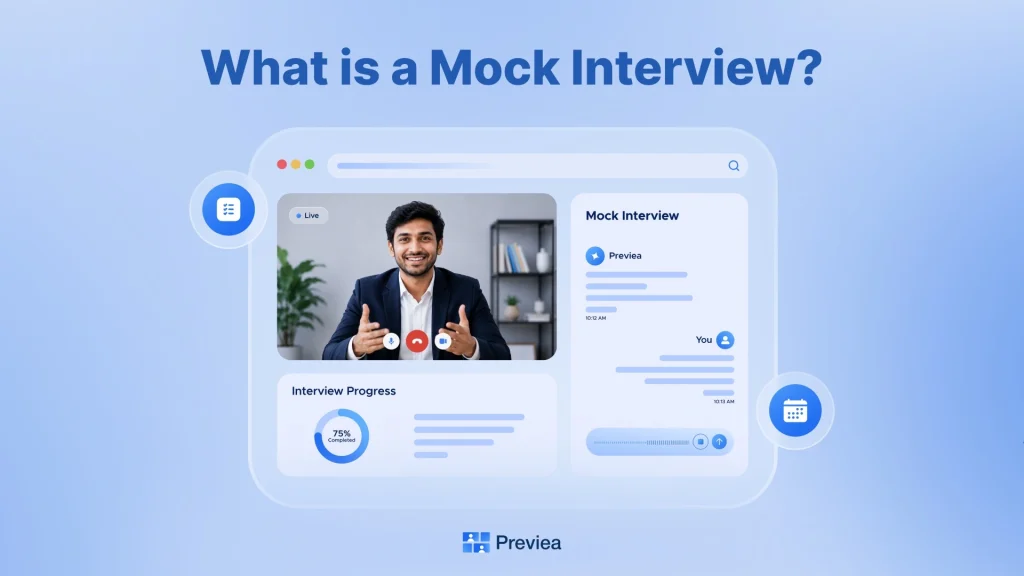
A mock interview is a practice session that closely matches the real interview setting. But it is not exactly the same as the real interview, as interviewers take every aspect of your response into final evaluation here.
For a fresher or entry-level candidate who is looking for a first job, a mock interview offers a clear advantage, as they come to know about their gaps before facing the final recruitment process. This guide covers different mock interview formats, preparation strategies, common questions, effective answering techniques, session expectations, common mistakes, and ways to assess interview readiness.
Mock Interview vs. Real Interview: What's Actually Different?
Mock interviews carry no real consequence for a candidate’s job prospects, while a real interview is a high-stakes evaluation process where every one of your responses directly impacts the final decision. Candidates get structured feedback and room to fix mistakes in a mock session. But there are limited or no second chances in real interviews.
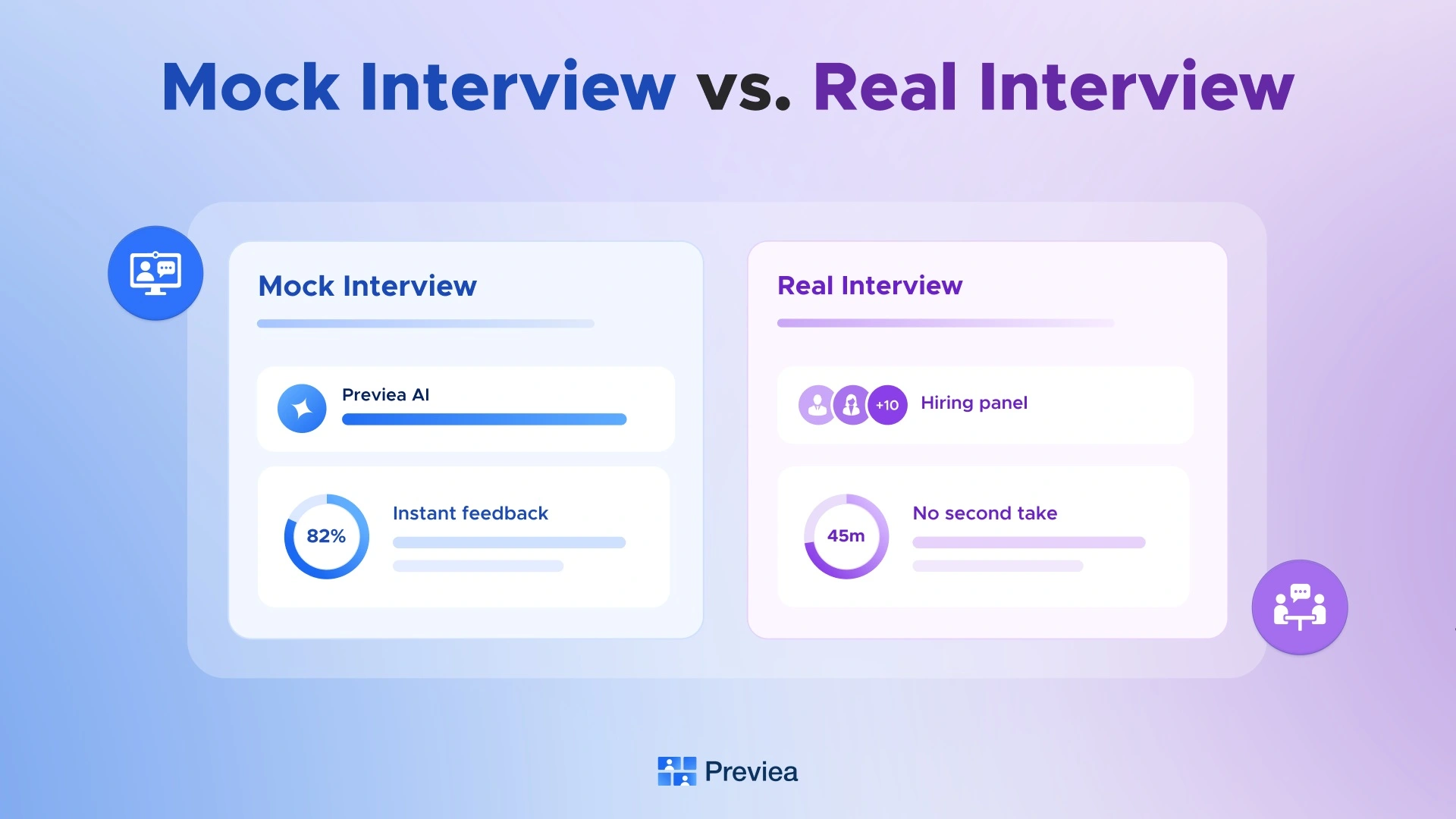
Let’s have a quick comparison table on mock interviews vs. real interviews to have a clear understanding of the differences between them:
| Aspect | Mock Interview | Real Interview |
|---|---|---|
| Purpose | Identify gaps, improve skills and help build confidence | Evaluate candidate fit and decide the final hiring outcome |
| Pressure | Low pressure in a safe, controlled environment | High pressure with real hiring consequences |
| Feedback | Immediate, detailed, and constructive | Limited or none; often only a final yes/no |
| Questions role-specific | Practice questions tailored to your target role | Questions based on the job’s requirements |
| Nerves | Helps manage nervousness safely and turn it into practice | You face stronger nerves with far less room to recover |
| Mistakes | You make mistakes freely and learn from each one | Mistakes directly hurt your hiring outcome and are hard to reverse |
| Value | Improves performance for the real interview | Determines whether you get the job offer |
Why Do Freshers Need Mock Interview Practice?
Freshers need professional mock interview practice because it transforms theoretical knowledge into real-world performance under pressure. Mock interviews expose blind spots that solo preparation can’t reveal.
Here’s why this matters specifically for freshers with no experience:
- Most interview fear among freshers comes from a lack of knowledge, but not from knowing the interview format. Mock sessions normalize question flow, pacing, and silence before the real interview day.
- Freshers often understand a concept but struggle to explain it in 60-90 seconds. Mock interviews reveal these theory-to-explanation gaps that resumes and written tests never show.
- Interviewers rarely give feedback and judge how freshers think and present beyond just correctness. Mock interviews help candidates answer clearly while improving their delivery, body language, and time management.
- Freshers face panel rounds, technical screens, and group discussions during campus placements. Mock interviews simulate each format, so candidates adapt faster to role-specific scenarios such as debugging talks, project deep-dives and support/DevOps situations.
- Consistent mock practice reduces nervousness across multiple sessions. Freshers approach the real interview with steadier composure and clearer thinking.
- Practicing alone can lead freshers to develop habits like rambling, unclear answers, or relying too much on memorized scripts. Mock interviews feel more like real conversations, with unexpected follow-up questions and feedback on things like phrasing and presence that you may not notice yourself.
What Types of Mock Interviews Should Freshers Practice?
Freshers can practice different types of mock interviews that build the skills and confidence needed for each entry-level hiring process.
| Type | What It Helps Freshers Practice | Best For |
|---|---|---|
| HR / Behavioral |
| Building confidence for the first round of most campus placements |
| Technical |
| Roles in IT, engineering, data, or any skill-based job |
| Panel |
| Final rounds in companies that use multi-interviewer formats |
| Group Discussion |
| Companies that use GD rounds in campus placement drives |
| AI / Self-Recorded |
| Independent practice and improving delivery without a human partner |
| Scenario-Based |
| Consulting project management and operational roles. |
How to Prepare for a Mock Interview Session as a Fresher?
Preparing for a mock interview means treating it like a real recruitment round. Freshers who follow a structured interview guide and checklist gather specific, measurable data about their performance.
Here’s a simple checklist every fresher should follow:
- Update and refine your target resume so every point highlighted there becomes clear again for you and ready to discuss.
- Build an experience bank of 6–8 personal experience-based answers from academics, internships, or extracurricular activities.
- Practice your answers around the STAR method. You will respond to every question with clear examples and, importantly, outcome-based.
- Do best research about the company and target role to have a good understanding of the requirements of the target role and their values.
- Prepare some of the common HR and technical questions based on your skills and target role.
- Practice speaking out loud and time your responses. This is important to improve clarity and pacing.
- Practice in a quiet space with a professional background. Check if there are stable internet connections if you are doing it through an AI mock interview tool.
- Ensure you keep a notebook so that you can note feedback immediately after the session.
Still confused? Read our detailed interview guide to get far more professional insights.
What Mock Interview Questions Should Freshers Prepare For?
A well-rounded question set covers every stage of the interview, from opening introductions to closing questions.
Here is a list of common interview questions for different situations:
Opening Questions
Interviewers use these questions to understand your background, interests, and career direction.
- Tell us about yourself.
- What are you currently studying or working on?
- Can you briefly describe your academic background?
- Why did you choose this field of study or career path?
- What are your career goals?
Strengths & Weaknesses
The questions are often asked to assess self-awareness, confidence, and areas for professional improvement.
- What is your biggest professional or academic strength?
- What is your biggest weakness?
- How do you handle feedback?
- How do you manage challenges during exams or deadlines?
- Which skill are you most confident about?
Behavioral Questions
Interviewers ask these questions to know how candidates handle challenges, teamwork, deadlines, and mistakes.
- Tell me about a time you faced a major challenge during a group project.
- Describe a situation where you had to manage short deadlines for multiple assignments or projects.
- Tell me about a project you are most proud of.
- Give an example of a time you failed and what you learned.
Technical or Role-Relevant Questions
Role-specific questions test your knowledge of core concepts, practical skills, tools, and industry developments.
- Explain a major concept from your subject
- How would you approach solving this basic problem or case?
- Which tools or technologies have you used in your projects?
- What recent industry trend in your field interests you?
- Tell me about a technical project you worked on.
"Why You, Why This" Questions
Questions in this category are asked to understand your interest in the role and the value your skills can bring to the organization.
- Why do you want to start your career with our organization
- What makes you a good fit for this position
- Where do you see yourself in the next few years?
- What unique perspective or skill set will you bring to our company?
The Questions Freshers Are Most Afraid Of (Gap Questions)
Gap-related questions reveal whether the candidates have limited experience, academic setbacks, career uncertainty, and workplace readiness.
- How do you explain the gap or lower grades in your academic transcript during this semester?
- Why don’t you have any internship experience?
- What will you do if you don’t get selected for this drive?
- How will you adapt to a professional work environment?
Salary & Logistics Questions
Practical questions cover compensation, availability, relocation, workplace arrangements, and working hours.
- What are your salary expectations?
- When can you start?
- Are you willing to relocate?
- Are you comfortable working from the office?
- Are you open to flexible working hours?
How to Answer Mock Interview Questions Effectively?
Freshers can answer mock interview questions confidently by following the STAR method. Technical questions need different approaches. Structure your responses around your problem-solving logic and speak out loud at a steady pace.
Here is a clear example you can utilize:
Question: Describe a project in which you had to handle a situation under a tight deadline:
Fresher STAR answer:
- Situation: This is the fact about our final-year web development capstone project. Our four-person team had three days left to submit our portal. But the team member who was responsible for backend development dropped out due to a personal emergency.
- Task: So, as a front-end lead, I had to take on the responsibility. I especially had to handle integrating the missing database endpoints so our submission would meet the requirements on time.
- Action: First off, I reframed our remaining work into priority tasks. After reviewing the API documentation, I built and tested the four essential database connections using Node.js. And for this, I maintained good communication with the rest of the team through daily updates so that they would be on track.
- Result: We submitted the working application four hours before the deadline. Subsequently, we achieved an A grade, which was really a proud moment for our team.
What to Expect During a Mock Interview Session?
Expect the session to start with a brief introduction. You’ll answer role-specific questions and follow-ups. The session concludes with feedback on your answers and communication.
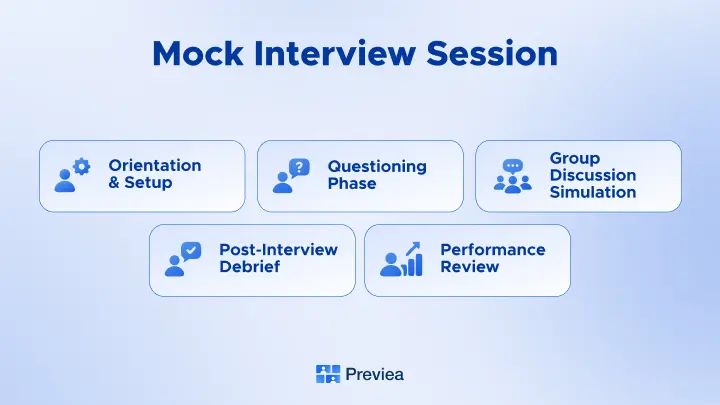
Here is the breakdown:
- Orientation & Setup: As for the first step, you can expect the facilitator to start with a brief introduction and explain the target role.
- Questioning Phase: The interviewer asks a mix of HR, behavioral, technical, and role-specific questions. The questioning phase tests how candidates think and respond under pressure.
- Group Discussion Simulation: As per the targeted role, candidates take part in a group discussion to practice clear communication and leadership within a time limit.
- Post-Interview Debrief: After the interview, the evaluator discusses your performance. The debrief covers answer quality, communication issues, and overall delivery.
- Performance Review: In the interview session, the candidates may get a scorecard. The scorecard covers strengths, weaknesses, and specific areas to improve.
What Common Mistakes Do Freshers Make During Mock Interviews?
Freshers make several common mistakes during mock interviews, such as:
- Repeating prepared answers word for word sounds robotic. Remember key points instead of memorizing full scripts.
- Slouching, fidgeting, or avoiding eye contact signals nervousness. Sit upright, hold relaxed eye contact, and use natural hand gestures.
- Nervousness causes rambling and rushed answers. Take a short pause before answering and speak at a steady pace.
- Using words such as “um,” “like,” and “you know” is a big mistake for the interviewer. Better you take 3 short pauses. A moment of silence sounds more confident.
- Generic answers signal unprofessionalism to interviewers. Review the job description and connect every answer to the role’s actual demands.
How Do You Know You Are Ready for the Real Interview?
Good preparation shows when you answer complex questions naturally, beyond memorized scripts, across different interview conditions.
Here is a quick checklist of the good signs you can compare:
- You can structure any complex technical answer into clear 2-minute STAR method answers.
- Now you have the confidence and maintain composure to face any new questions related to your job role.
- Your practice frequency has been consistent, likely multiple sessions over weeks.
- You have completed multiple feedback loops and efficiently worked on these to refine yourself.
Where Can Freshers Practice Mock Interviews?
Freshers can practice mock interviews online through AI-powered platforms. AI mock interview platforms solve the biggest problem candidates face, like finding quality practice partners or experienced mentors.
Modern AI mock interview platforms like Previea offer realistic online practice that is accessible anytime. Candidates rehearse under interview conditions without the need to coordinate schedules with others.
Previea has free mock interview sessions with instant AI-powered insights and feedback systems after every attempt. Previea allows you to access role-specific questions that are customized based on your exact background and targeted roles. Consistent use of mock interview tools steadily builds interview confidence and supports long-term career success.
Frequently Asked Questions
Do mock interviews help if I have zero work experience?
Yes, mock interviews help freshers with zero professional background. Candidates gain confidence, build interview skills, and learn how to present their strengths effectively.
How do I know if my mock interview answers are good?
A good sign that your answers are going well is answering with the STAR method. There should be no filler words or generic terms. Most importantly, they are built on clarity and real examples.
What if I don't know the answer to a question they ask?
Just stay calm and politely admit what you do not know honestly. There is a good trick here: you can then share related knowledge or how you would approach finding the solution.
How many mock interviews should I do before the real interview?
About 4–6 focused sessions spread over weeks are right to well prepare for the real interview. But you have to be consistent until you have confidence in yourself.
What should I wear for a mock interview?
Dress exactly as you would for the real interview. Just go for formal or business casual depending on the role.